
Foundation Water Guide • Northern Virginia
Does Basement Water Need Drainage, Waterproofing, or Foundation Repair?
Water in a basement or along a foundation can have several connected causes. The visible leak location is not always where the water first entered the surrounding system.
Direct Answer
Basement Water: Drainage, Waterproofing, or Foundation Repair?
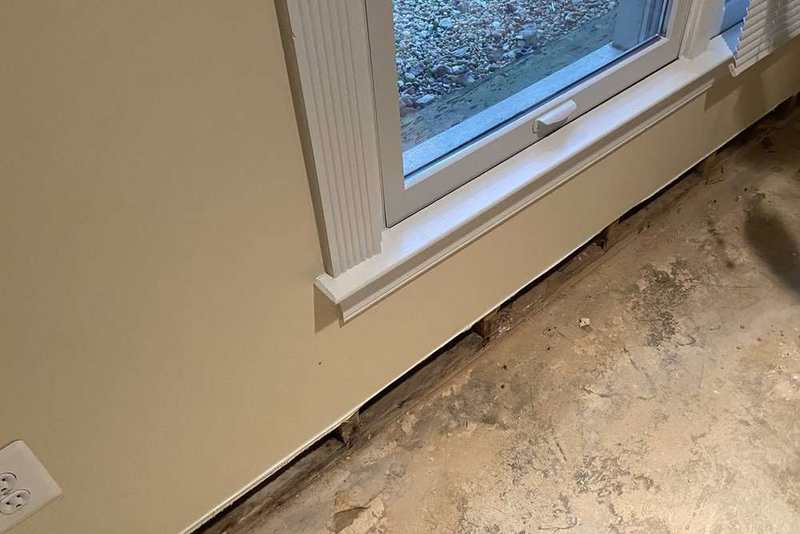
Basement water may require exterior drainage correction, foundation waterproofing, crack repair, footer-drain work, interior collection, or a coordinated combination. Structural foundation repair is appropriate only when movement, damage, or loading—not moisture alone—creates a structural need.
What to Know
Start Outside the Foundation
Roof water, negative grading, saturated planting beds, blocked drainage, and hardscape sloping toward the home can repeatedly load the soil beside a foundation.
- Downspouts discharging close to the wall
- Soil or mulch pitched toward the house
- Patios, walks, or driveways holding water beside the structure
- A failed or missing footing-drain outlet
- Sump discharge cycling water back toward the foundation
- Erosion or ponding that appears after the same storms as the leak
What to Know
Separate Water Sealing from Structural Stabilization
Waterproofing and structural repair solve different problems. A crack can leak without showing structural movement, and a moving wall can require stabilization even if it is currently dry.
- Seepage at a wall-floor joint may indicate water pressure near footing level
- A leaking concrete crack may be a candidate for injection after evaluation
- Masonry walls may require different repair and waterproofing methods
- Stair-step cracking, displacement, bowing, rotation, or settlement can justify engineering review
- Finishes should not conceal an unresolved water or movement source
What to Know
Build the Scope Around the Cause
A durable proposal identifies the likely source, the collection or protection method, the discharge route, access and excavation needs, restoration, and any engineering or permit requirements.
- Correct roof-water and surface-drainage contributors
- Define exterior, interior, or combined waterproofing measures
- Repair suitable cracks with a method matched to the wall and condition
- Restore or replace footer drainage when the evidence supports it
- Coordinate structural design and stabilization when movement is present
Related Service
Move from Research to an On-Site Evaluation.
Review the complete foundation repair & waterproofing scope, then request a free estimate when you are ready for Constructology to look at the property.
Frequently Asked Questions
Helpful Answers
Does every basement leak mean the foundation is failing?
No. Many leaks relate to grading, roof runoff, drainage, joints, cracks, penetrations, or waterproofing. Structural concerns require separate evaluation.
Should drainage be corrected before waterproofing?
The complete cause should be evaluated first. Some projects need drainage correction, some need waterproofing, and others need both in a coordinated scope.
Can a foundation crack be injected?
Certain concrete cracks may be suitable for injection. Wall material, crack geometry, moisture, movement, and water pressure affect the repair method.
When should an engineer evaluate a foundation?
Engineering may be appropriate when there is settlement, displacement, bowing, rotation, significant cracking, altered loading, or a proposed structural repair requiring designed details.
Continue Learning
Related Construction Guides
Does a Retaining Wall Need an Engineer in Northern Virginia?
Learn when a Northern Virginia retaining wall may need engineering, permits, drainage design, or contractor coordination before construction or repair.
Read the GuideFrench Drain vs. Grading vs. Swale | Northern Virginia
Compare French drains, grading, drainage swales, catch basins, and connected yard-drainage solutions for Northern Virginia properties.
Read the GuideYard Drainage: Find the Water Source, Route, and Outlet
Learn why a Northern Virginia yard-drainage plan should trace where water starts, how it moves, and where it can discharge before choosing a French drain, swale, grading, catch basin, or downspout route.
Read the GuideExterior Foundation Waterproofing Scope Checklist
A Northern Virginia homeowner's guide to comparing exterior foundation waterproofing proposals: diagnosis, excavation, wall preparation, waterproofing, drainage, backfill, restoration, and exclusions.
Read the GuideConcrete Steps, Walkways, and Landings: Repair or Replace?
Learn when damaged concrete steps, walkways, and entry landings in Northern Virginia may be repaired and when selective or complete replacement is more practical.
Read the GuidePaver or Flagstone Walkway: Repair, Relevel, or Rebuild?
Learn when a settled paver or flagstone walkway in Northern Virginia can be relevelled and when base, drainage, edge, or layout failures make rebuilding more practical.
Read the Guide