
Hardscape Repair Guide • Northern Virginia
Should a Settled Paver or Flagstone Walkway Be Repaired or Rebuilt?
Uneven pavers, loose flagstone, open joints, rocking stones, and low spots can come from several different failures. A useful repair decision starts below the visible surface—with the base, edge restraint, water route, transitions, and amount of movement.
Direct Answer
Paver or Flagstone Walkway: Repair, Relevel, or Rebuild?
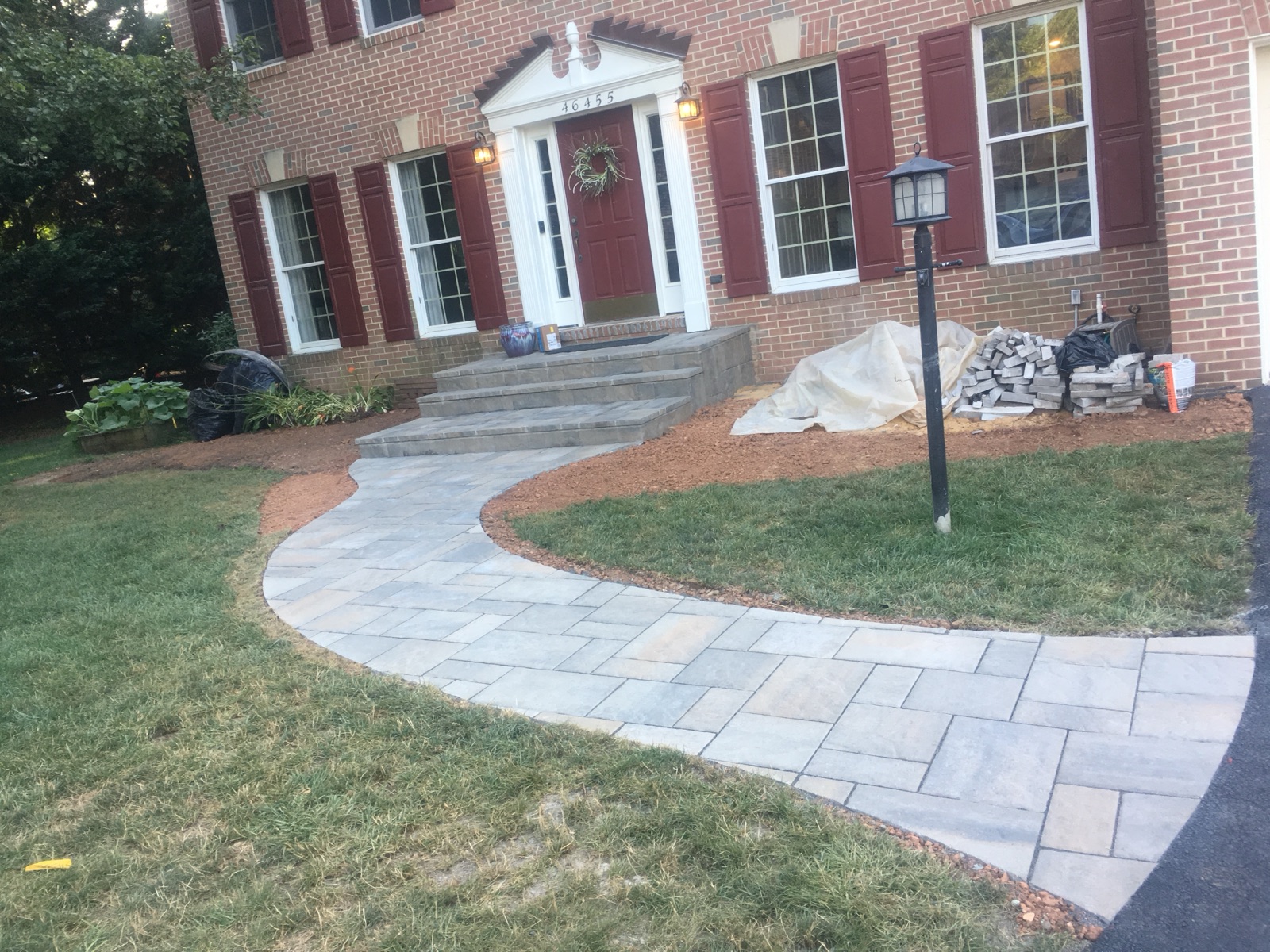
Localized paver or flagstone sections may be lifted and relevelled when the surrounding base remains stable, the failure has a defined cause, drainage can be corrected, and the repaired area can transition cleanly into the remaining walkway. Rebuilding is usually more practical when settlement is widespread, the base or edge system has failed, water repeatedly enters or crosses the assembly, the layout creates unsafe transitions, or too much of the existing work must be disturbed for a durable repair.
What to Know
Why Pavers and Flagstone Settle
The visible low stone is often the symptom, not the complete problem. Water, soil movement, insufficient base preparation, loss of edge support, roots, freeze-thaw cycles, and concentrated foot traffic can all change the support below a walkway.
- Base aggregate that was too thin, unevenly compacted, or placed over weak soil
- Roof or surface water entering the walkway and carrying bedding material away
- Missing or failed edge restraint that allows pavers to spread
- Tree roots or disturbed soil lifting and dropping individual areas
- Poor transitions at steps, driveways, gates, patios, or public sidewalks
- Open joints, loose stones, or repeated patching that no longer holds the assembly together
What to Know
When a Focused Releveling May Work
A focused repair can be sensible when movement is limited and the adjacent construction gives the repaired section stable boundaries. The scope still needs to correct the cause instead of only raising the finished surface.
- One or several defined low areas with sound surrounding work
- Pavers or stones that can be removed without excessive breakage
- A base that can be rebuilt and compacted within practical repair limits
- An edge, step, or hardscape boundary that can be restored securely
- Surface slope and drainage that can be corrected within the available elevations
- A repair area that can blend reasonably with aged materials and joints
What to Know
When Rebuilding Is Usually More Practical
Rebuilding becomes the clearer scope when the failure is systemic or when a partial repair would leave the same water, support, layout, or safety problem in place.
- Settlement, rocking, or spreading across much of the walkway
- Recurring ponding or runoff moving through the bedding and base
- Failed steps, inconsistent risers, or unsafe transitions tied to the walkway
- Widespread edge loss or a layout that cannot be restrained effectively
- Extensive broken flagstone, incompatible patch materials, or poor prior repairs
- A repair footprint large enough that selective work would create uncertain limits and value
What to Know
Photos That Help Prequalify the Project
Photos and rough measurements can help identify whether a walkway repair is a plausible short-cycle project. Final scope may still require field verification of elevations, drainage, access, utilities, roots, base conditions, and material availability.
- One wide photo showing the entire route and both end points
- Medium views of every settled, loose, or ponding area
- Close photos showing joints, edges, cracks, and height differences
- Views taken after rain when water movement is part of the concern
- Approximate walkway length, width, and number of steps
- ZIP code plus photos of crew and material access to the work area
Related Service
Move from Research to an On-Site Evaluation.
Review the complete walkways & pathways scope, then request a free estimate when you are ready for Constructology to look at the property.
Frequently Asked Questions
Helpful Answers
Can only the settled pavers or stones be lifted and reset?
Sometimes. A localized reset is most practical when the failure limits are clear, adjacent work is stable, reusable material is available, and the base, edge, and drainage cause can be corrected within the repair area.
Will repaired pavers or flagstone match the existing walkway?
Exact matching is not guaranteed. Existing materials weather, natural stone varies, and replacement products may differ in color, thickness, texture, or size. Those expectations should be reviewed before work begins.
Can drainage be corrected while repairing the walkway?
Often. Surface slope, adjacent grading, downspout routing, edge conditions, catch basins, or other drainage measures can be evaluated as part of the connected scope.
Does polymeric sand fix a settling walkway?
Joint material can help stabilize suitable paver joints, but it does not rebuild a weak base, correct poor drainage, restore failed edges, or level stones that have already moved.
Can photos provide a final repair price?
Photos can help prequalify the opportunity, but final scope and pricing may require an on-site review of movement, elevations, access, drainage, base failure, roots, material reuse, and transitions.
Continue Learning
Related Construction Guides
How to Review a Multi-Scope Outdoor Construction Proposal
A Northern Virginia guide to comparing coordinated drainage, concrete, hardscape, grading, restoration, engineering, allowances, exclusions, and project sequencing before approving an outdoor construction proposal.
Read the GuideDoes a Retaining Wall Need an Engineer in Northern Virginia?
Learn when a Northern Virginia retaining wall may need engineering, permits, drainage design, or contractor coordination before construction or repair.
Read the GuideFrench Drain vs. Grading vs. Swale | Northern Virginia
Compare French drains, grading, drainage swales, catch basins, and connected yard-drainage solutions for Northern Virginia properties.
Read the GuideYard Drainage: Find the Water Source, Route, and Outlet
Learn why a Northern Virginia yard-drainage plan should trace where water starts, how it moves, and where it can discharge before choosing a French drain, swale, grading, catch basin, or downspout route.
Read the GuideBasement Water: Drainage, Waterproofing, or Foundation Repair?
Understand whether basement water may begin with grading and drainage, waterproofing failure, a leaking crack, or a structural foundation concern.
Read the GuideExterior Foundation Waterproofing Scope Checklist
A Northern Virginia homeowner's guide to comparing exterior foundation waterproofing proposals: diagnosis, excavation, wall preparation, waterproofing, drainage, backfill, restoration, and exclusions.
Read the GuideConcrete Steps, Walkways, and Landings: Repair or Replace?
Learn when damaged concrete steps, walkways, and entry landings in Northern Virginia may be repaired and when selective or complete replacement is more practical.
Read the Guide